Today would have been my Grandpa Kenneth Hatch’s 100th Birthday. He made it to 96 years of age before passing away, four years ago this March.
Grandpa lived most of his life in the town of Randolph, Utah a town of about 500 to 1000 people (population has varied from time-to-time over the last century) and well-known for is cold temperatures. His family moved there when he was 3 years old in 1910. Outside of the 2 years he spent on his mission, and a few months away as a student at the University of Utah -- he spent 91 of his 96 years in Randolph. Whenever he was away from town for any length of time, he would become restless and fidgety and would want to return home as soon as possible.
It was not an easy life for grandpa in Randolph. At age 14, his father was killed in a gun accident. Someone came to visit my great-grandfather at his sheep camp. The visitor had looked at the rifle, leaned it on the wagon wheel of the sheep camp and went inside to visit. Somehow the sheep camp was jostled and the gun fell and discharged, which fatally wounded Grandpa's father.
From that time on, grandpa tried to help support himself as much as possible. He began with 3 pet lambs, which eventually grew to 15 head of sheep. He also raised calves, and trapped muskrat, skunks and coyotes to earn money. Through these activities, he was able to help pay for the expenses associated with going to high school, and 1 semester at the University of Utah.
In about 1928, he bought some land on Little Creek, about 5 miles outside of town. Later when Grandpa was called on a mission, he leased this land to his brother-in–law while he was away.
Missionary ExperiencesIn 1929 he was called to serve in the Western States Mission, which was headquartered in Denver, Colorado. He left on April 13, 1929. He first went to Salt Lake City to go to the temple, and receive instruction from General Authorities before proceeding to his assignment. He received instruction from David O McKay, and James E. Talmadge, among others. On April 25, 1929 he boarded a train to Denver, Colorado. When he arrived, he found that his mission president, Elias S. Woodruff, (son of Wilford Woodruff) had been born in Randolph in the Woodruff log cabin (which now is a historical site).
Grandpa Described some of his first missionary experiences in his journal as follows:
- On the second day of his mission, he had his first experience riding a bicycle.
- On May 27, 1929, he had his first experience as a missionary with a dog. Grandpa said: “It was little, and it was brown, and he had me by the leg!”
- On June 19, 1929 he had his first street meeting, which he described as: “Kind of a shaky business.”
Meeting GrandmaOn October 20, 1929, grandpa was diagnosed with appendicitis. He was sent by train from Grand Junction, CO to Salt Lake City for treatment.

While in the hospital, a certain student nurse, named Lucille, admitted him to the hospital.
Well, one thing led to another, and sparks began to fly. Lucille managed to find clever ways for them to meet together. Her friend and roommate, named Fern, was the assigned to take care of him. Fern arranged ways for Lucille to meet up with grandpa, even though she wasn’t exactly
assigned to take care of him.
After being released from the hospital, Grandpa stayed in Salt Lake with his Aunt Algie, for about 6 weeks until he was able to return to his mission. All I can say is that Mission Rules must have been WAY different in those days. During that time, Grandpa and Lucille were able to go on a few dates, and spend time together during her off hours. On December 1, 1929, Grandpa returned to his mission, but not before giving Lucille an engagement ring first!
Grandpa received an honorable release from his mission on April 22, 1931. A year later, he and Lucille were married in the Cardston, Alberta temple on May 5, 1932.
Hard timesCircumstances had changed a lot since Grandpa had left for his mission. The stock market crashed while he was in the hospital with appendicitis. By the time he got home, the Great Depression had set-in. Times were tough. Cash was hard to come by. There were times when they had to live on game meat. He and his brother-in-law (Uncle Hyrum) would gather firewood together up Old Canyon to burn in their stoves. Coal stoves were used to heat their home in the cold Randolph winters (Temperatures can reach 30-40 degrees
below zero in the winter!) They would milk several cows, by hand, twice a day in order to sell milk to the local creamery. Grandma earned some money as well by working as a county nurse, and traveled all about Rich County on horseback, and by hitching rides with the mail carrier to Woodruff and Laketown.
Grandpa told the story of when he and grandma had to take out a loan for a sewing machine when they were first married. He just hated having to make payments “on time” as he called it. They paid off that sewing machine as quickly as they could. Grandpa would never again incur any other debts throughout his life, with the exception of mortgages for land purchases – which he also always paid off early. He was always very frugal and careful with how he spent his money.
On the other hand, Grandpa was also very generous with is money. There were many people who he would help who were in need, always in a very quiet way. Sometimes that help involved bringing young men, who we would call “at-risk” youths nowadays, to the ranch to work. The deal was: he would give them a job, and they would stay out of trouble. Grandma and Grandpa maintained lifelong relationships with some of these young men.
The Ranch
Grandpa Hatch would eventually purchase additional tracts of land that adjoined his property. Eventually he would own nearly 2,000 acres of land. About 800 acres of it was cultivated farmland, with the remainder being rangeland for pasturing livestock.
Grandpa started out as a sheep rancher, but converted to cattle in the late 1940’s. Eventually he would have about 250 head of cattle. He would raise the calves each year, and eventually would sell them to feed lots in the Midwest, where the calves would be raised until they were ready to go to market.
One unique thing about grandpa’s cattle operation was that he always raised enough hay and grain to feed his cattle through the winter. He never had to buy feed for his cattle from others. In this way he was always self-sufficient. In fact, he would usually sell any extra hay to his neighbors, and extra grain to feed companies, which provided a little extra income.
However selling the calves each year was his main source of income. Income would vary depending on the number of calves, and upon market prices each year. Cattle buyers would visit him each year. They would offer to contract with him to buy calves at a fixed price in the fall – call it cattle futures. He could contract with one of these buyers if he wanted to, or he could wait until the fall (usually around November each year) and get whatever the going rate was at the time. He had to know the market enough to decide whether to contract early, or wait for the fall market prices if he thought the contract price offered was a low-ball offer (which they usually were.)
Grandpa would save as much money as he could each year. Eventually he would have a large enough nest egg, that he was able to finance his own operations even in the lean years, without having to take out loans. It always amazed me to go with him to a car dealership, or an implement company and see him write out a check for a new car, truck, or a new tractor. (Actually, it was Grandma who wrote out all the checks.) But that’s just the way he did things. He was able to achieve relative financial security as a result.
Family and ChurchGrandpa Served in many church callings. His two favorite assignments were as Stake Mission President, and as an ordinance worker in the Ogden Temple. In each of these, he was able to use his outgoing, gregarious personality as he reached out to others, in the service of God.
Grandma and Grandpa had 4 daughters, 17 grandchildren, and many great-grandchildren. I was the third grandchild, and the first grandson. As such I was the first boy in the family. I spent all of my summers as I was growing up on grandpa’s ranch. It was a wonderful opportunity that I will always cherish. You can read more about my experiences on the ranch
here.
After the RanchWhile I was on my mission, grandpa sold the ranch. He was nearly 70 years old at the time, and age was catching up with him. It was probably the right decision, but selling the ranch nearly broke his heart. There is something about putting so much of yourself – literally your blood, sweat, and tears into the land. Then not to have that land any longer – your whole life’s work – its almost too much to take. So many memories, over every inch of that land. Land that he had worked for more than 50 years! Grandpa could hardly drive past the ranch in his later years. It was just too painful for him to even look at -- knowing that it was not his anymore.
I think I know a little of how he felt. So many of my memories are in that place. My memories only span a period of about 15 years. However they were my formative years as I was growing up, and my experiences on there on the ranch are forever embedded into who I am. The ranch will always be a part of me that I will carry with me, wherever I go for the rest of my life. When I drive past the ranch now, the memories flood through me as well. Now that grandpa is gone, I see things that no one else sees. I know things about that place that no one else knows – even things that the current owners will never know.
Grandpa was always a busy, up-and-doing "Type A" kind of person. Having nothing to get up for each morning really made him feel like he was not being useful. He tried to busy himself by helping out on his nephew’s ranch, but that didn’t really make him feel useful either. Finally, he and grandma became Temple workers, and then they felt like they were doing something useful and worthwhile once more.

Being a temple worker also worked on him. I noticed that some of the rough edges – like salty language, etc. – that you might expect to find in a rancher disappeared after he worked in the temple. His temple service in turn served to refine an polish him in his later years.
Then came the years of declining health. Grandma’s health failed first. Grandpa took care of her the best he could, with the assistance of my mother. Eventually grandma passed away. My mother continued to assist grandpa for another 5 years, until grandpa got his final wish – to be reunited with his eternal sweetheart.
We miss grandma and grandpa Hatch. They were fine people, who have given us, their family, a wonderful heritage and legacy. We look forward to being reunited with you again one day.
Happy Birthday, Grandpa!
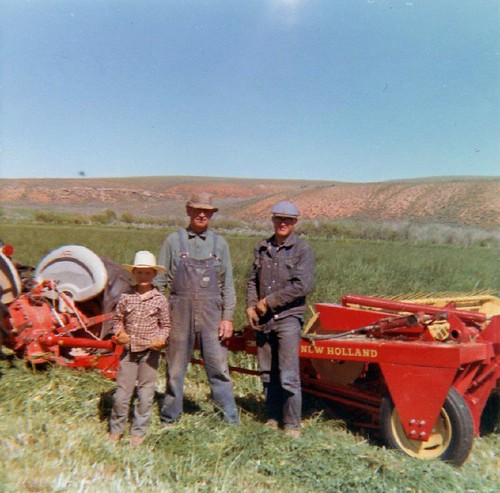 I have recently been scanning some photos that were taken of my Grandpa's ranch, and his family.